


The global minerals industry operates on a foundation of high risk and high capital investment. To function effectively, this market requires a mechanism to build trust and provide a common ground for evaluating the potential value of mineral assets. The Australasian Code for Reporting of Exploration Results, Mineral Resources and Ore Reserves, universally known as the JORC Code, serves as this fundamental mechanism. It is not a government regulation or a technical manual for mining; rather, it is a professional code of practice that establishes the minimum standards for how companies publicly report information about their mineral projects.
1.1 Defining the JORC Code: A Global Standard for Investor Confidence
The JORC Code provides a mandatory system for classifying mineral Exploration Results, Mineral Resources, and Ore Reserves based on defined levels of geological confidence and the assessment of technical and economic factors. Its primary purpose is to ensure that Public Reports—which include everything from stock exchange announcements and annual reports to website postings and investor presentations—provide sufficient information for investors and their professional advisors to make reasoned and balanced judgments about a mineral project.
The Code’s authority stems from its incorporation into the Listing Rules of major stock exchanges, most notably the Australian Securities Exchange (ASX) and the New Zealand Stock Exchange (NZX), making compliance mandatory for any listed company reporting on mineral assets. The Code is produced and maintained by the Joint Ore Reserves Committee (JORC), a body representing a tripartite of key industry organizations: The Minerals Council of Australia (MCA), The Australasian Institute of Mining and Metallurgy (The AusIMM), and the Australian Institute of Geoscientists (AIG). Furthermore, JORC is a key member of the Committee for Mineral Reserves International Reporting Standards (CRIRSCO), which works to align reporting standards globally, ensuring that a JORC-compliant report is understood and respected internationally.
The fundamental contribution of the JORC Code is its role as a market-enabling mechanism. By creating a standardized lexicon and a clear framework for classification, it reduces information asymmetry between mining companies and the investment community. This common language allows for the meaningful comparison of different projects, fostering the transparency and confidence necessary to attract capital into the inherently speculative and high-risk business of mineral exploration and development. It transforms geological potential into a communicable and comparable asset class, underpinning an efficient and informed market.
1.2 The Three Pillars: A Deep Dive into Transparency, Materiality, and Competence
The operation and application of the JORC Code are founded on three guiding principles: Transparency, Materiality, and Competence. These are not merely aspirational ideals but form an enforceable ethical framework that governs all public reporting.
- Transparency: This principle requires that a Public Report provides sufficient information, presented in a clear and unambiguous manner, so that a reader can understand its contents and not be misled. This includes preventing misunderstanding that could arise from the omission of relevant information known to the reporting party.
- Materiality: This principle demands that a Public Report contains all the information that investors and their professional advisors would reasonably require and expect to find for the purpose of making a balanced judgment regarding the project. If relevant information is omitted, a justification must be provided. The benchmark for materiality is whether the presence or absence of a piece of information could influence the perception of the project’s value.
- Competence: This principle mandates that Public Reports must be based on work that is prepared by, or under the direction of, a suitably qualified and experienced professional. This individual must be subject to an enforceable professional code of ethics and conduct.
These three pillars are interconnected and form a robust system of accountability. The entire structure of JORC reporting, particularly the detailed checklists in Table 1, serves as the practical application of these principles. A failure to be transparent about a material issue is a direct violation of the Code. Because the work must be signed off by a professional who is a member of an organization with enforceable disciplinary processes, these principles carry significant weight. This makes the framework a powerful tool for ensuring accountability and maintaining the integrity of public reporting in the minerals sector.
1.3 The Role of the Competent Person: The Linchpin of the JORC Framework
Central to the principle of Competence is the role of the Competent Person (CP). The JORC Code defines a CP as a minerals industry professional who is a Member or Fellow of The AusIMM, the AIG, or another Recognised Professional Organisation (RPO) with enforceable disciplinary powers.
The requirements for a CP are stringent and specific. An individual must have a minimum of five years of experience that is relevant to two things simultaneously: the style of mineralization or type of deposit being considered, and the specific activity being undertaken. For example, a geologist with 20 years of experience in massive sulphide deposits may not be a CP for a report on alluvial gold, as the sampling and evaluation techniques are vastly different. Similarly, a CP for a Mineral Resource estimate must have relevant experience in resource estimation, while a CP for an Ore Reserve estimate must have relevant experience in the technical and economic evaluation required for reserve conversion.
The CP takes personal responsibility for the work. For any Public Report, the CP must provide prior written consent to the release of their information in the form and context in which it appears. This makes the CP the linchpin of the entire system, as their professional reputation and standing are tied directly to the accuracy and integrity of the report.
The increasing complexity of mining projects, particularly with the rise of Environmental, Social, and Governance (ESG) considerations, has highlighted the challenge for a single individual to possess deep expertise across all relevant domains. In recognition of this, the proposed 2024 update to the JORC Code introduces the formal role of a “Specialist”. This allows the CP to rely on the work of other qualified professionals (e.g., environmental scientists, geotechnical engineers, hydrogeologists) for specific sections of a report. While the Specialist provides their expert input and consent, the CP retains overall responsibility for critically reviewing the Specialist’s work and ensuring it is presented in a manner that is not misleading. This evolution marks a significant shift from a single-point-of-accountability model to a more robust, team-based approach that enhances the quality of reporting while protecting the CP from being held responsible for matters outside their direct expertise.
Part I: The Foundation of Truth – Data Acquisition and Verification
The entire JORC classification system, from a speculative Exploration Result to a high-confidence Proved Ore Reserve, is built upon a pyramid of data. The quality and integrity of the data at the base—collected through drilling and sampling—determine the reliability of everything that follows. The JORC Code, through the detailed criteria in Table 1, mandates rigorous disclosure of how this foundational data was acquired and verified.
2.1 Drilling Techniques and Best Practices
The first step in understanding a potential mineral deposit below the surface is typically drilling. The JORC Code requires a Public Report to specify the drilling techniques used, as different methods have different strengths, weaknesses, and potential for bias. Common methods include:
- Diamond Core Drilling (DD): This method uses a diamond-impregnated bit to cut a solid cylinder of rock (core), which provides the most detailed geological and structural information. The report must state details such as core diameter and whether the core was oriented to determine the in-situ orientation of geological structures.
- Reverse Circulation (RC) Drilling: This method uses a pneumatic hammer to produce rock chips, which are brought to the surface inside the drill rods. It is faster and cheaper than diamond drilling but provides less structural information.
- Other Methods: Various other methods like rotary air blast (RAB), auger, or sonic drilling may be used, particularly in early-stage exploration, and must be clearly described.
Of paramount importance is drill sample recovery. The Code requires reporters to state how recovery was measured and what the results were. Full or high recovery means that the sample collected is likely to be representative of the interval drilled. Conversely, poor recovery—where a significant portion of the drilled rock is lost and not collected—is a major red flag. This is because the loss may be preferential; for instance, softer, friable, or highly fractured zones, which are often associated with higher-grade mineralization, may be washed away during drilling. This would result in a sample that is biased and under-represents the true grade of the deposit. A Competent Person must assess whether a relationship exists between sample recovery and grade and discuss any potential for bias. Reports often state high recovery rates (e.g., >90%) as a key indicator of data quality.
Finally, all recovered material, whether core or chips, must be geologically and/or geotechnically logged by a qualified person. This logging, which can be qualitative (describing rock type, alteration) or quantitative (measuring fracture frequency), must be done to a level of detail sufficient to support subsequent Mineral Resource estimation and mining studies.
2.2 Sampling Protocols and Preparation
Once the drill has brought rock to the surface, a sample must be taken for laboratory analysis. The goal of all sampling and sub-sampling procedures is to obtain a small aliquot of material (typically a few kilograms or less) that is truly representative of the entire drilled interval from which it was taken. The JORC Code requires explicit disclosure of these procedures.
For diamond core, the report must state if the core was sawn or split, and what portion was taken for the sample—typically half-core is sent for assay, with the other half retained for reference. For RC chips, which can amount to many tens of kilograms per metre, the method of splitting must be described. Common methods include using a riffle splitter or a rotary splitter to obtain a manageable and representative sub-sample.
The appropriateness of the final sample size must be considered relative to the grain size and nature of the mineralization. For example, a deposit with coarse, nuggety gold requires different (and often larger) sample sizes and preparation techniques than a deposit with finely disseminated mineralization to avoid sampling bias.
Finally, the report must describe the measures taken to ensure sample security. This “chain of custody” from the drill rig to the laboratory is crucial for ensuring that samples are not accidentally mixed up, contaminated, or tampered with, thereby guaranteeing the integrity of the results.
2.3 The Non-Negotiable Imperative of QA/QC
Quality Assurance (QA) refers to the planned systems and procedures put in place to ensure data quality, while Quality Control (QC) refers to the measures used to verify that the systems are working effectively. A comprehensive, independent QA/QC program is a mandatory component of any modern, credible mineral exploration program and is a key focus of JORC reporting. Its purpose is to act as an independent, “blind” audit of the analytical laboratory’s performance, as relying solely on a laboratory’s internal QC is considered unacceptable practice.
The program involves systematically inserting various control samples into the routine sample stream sent for analysis. The laboratory does not know which samples are the controls, allowing for an unbiased assessment of its performance. The three main types of control samples are:
- Certified Reference Materials (CRMs): Also known as “standards,” these are samples of powdered rock that have been assayed by multiple laboratories to establish a certified, known concentration of the element(s) of interest. They are used to monitor the accuracy (how close the lab’s result is to the true value) of the analytical process.
- Blanks: These are samples of material known to contain no detectable mineralization (e.g., barren rock or sand). They are inserted into the sample stream to monitor for contamination during the sample preparation and analytical stages. A high-grade result from a blank sample indicates a serious problem at the laboratory.
- Duplicates: These involve taking a second sample from a primary sample at various stages to monitor precision (the repeatability of a measurement).
- Field Duplicates are a second sample taken from the same drill interval at the rig (e.g., the other half of the core, or a second split of RC chips). They measure the total combined variability of the deposit itself plus all subsequent sampling and analysis steps.
- Crush and Pulp Duplicates are taken after crushing or pulverizing stages at the laboratory and measure the precision of the laboratory processes.
A common industry standard is for control samples to make up at least 5% of the total samples submitted, though this can vary depending on the project stage and mineralization style. The results of the QA/QC program must be monitored in a timely manner, and any failures (e.g., a CRM result outside of acceptable limits) must be investigated and rectified. The JORC Code requires that the nature of the QA/QC procedures and a summary of the results be disclosed in Table 1. A project with a poor or non-existent QA/QC program has data of unknown and unverifiable quality, which severely undermines the credibility of any subsequent resource estimate.
| Control Sample Type | Purpose | Common Insertion Rate | Example (per 100 primary samples) |
|---|---|---|---|
| Certified Reference Material (CRM) | To monitor accuracy of the laboratory analysis. | 1 in 20 to 1 in 50 | 2-5 CRM samples |
| Coarse Blank | To monitor for contamination during sample preparation and analysis. | 1 in 50 to 1 in 100 | 1-2 Blank samples |
| Field Duplicate | To monitor overall precision (geological + sampling + analytical variance). | 1 in 20 to 1 in 50 | 2-5 Duplicate samples |
| Total Control Samples | 5-12 (5-12% of total submission) |
Part II: The JORC Classification Pathway
Once reliable data has been collected and verified, the Competent Person can begin the process of interpreting that data to define and classify the mineral endowment. The JORC Code provides a clear, step-by-step pathway that moves from initial, speculative findings to robust, economically evaluated reserves. This progression is based on increasing levels of geological knowledge and confidence.
3.1 Step 1: Reporting Exploration Results
This is the earliest stage of public disclosure, often following an initial drilling program. Exploration Results can include data from drill holes, trenches, or geochemical surveys. The JORC Code places strict rules on this type of reporting to prevent companies from being overly promotional or misleading.
The paramount requirement is for balanced reporting. This means a company cannot selectively report only its best drill intercepts while omitting the poor or unmineralized ones. Where comprehensive reporting of all results is not practical, the report must be representative of both high and low grades to avoid creating a misleading impression of the project’s potential.
Furthermore, all material information must be included, such as tables detailing drill hole collar locations, depths, and azimuths. A critical reporting detail relates to the width of mineralization. Drill intercepts are measured as “down-hole length.” However, if a drill hole intersects a mineralized body at an oblique angle, the down-hole length will be much longer than the “true width” of the body. Reporting a long down-hole intercept without context can be highly misleading. Therefore, the Code requires that if the true width is known, it should be reported. If it is not known, the report must include a clear statement to that effect, such as “down hole length, true width not known”. These rules are designed to enforce scientific and contextual honesty at the most speculative stage of a project’s life.
3.2 Step 2: Defining a Mineral Resource
As exploration continues and the geological understanding of a deposit grows, the Competent Person may be able to estimate a Mineral Resource. A Mineral Resource is defined as a concentration of material in or on the Earth’s crust in such form, grade, and quantity that there are reasonable prospects for eventual economic extraction (RPEEE).
The RPEEE concept is the first major economic filter applied in the JORC process. It requires the Competent Person to make a professional judgment that, based on a set of reasonable assumptions about potential mining and processing methods, the deposit could plausibly be mined profitably at some point in the future. This is not a full feasibility study, but it prevents purely geological anomalies with no conceivable path to economic viability from being classified as a resource. The significance of this hurdle is evolving; the proposed 2024 JORC update seeks to remove the word “eventual” to discourage the reporting of resources based on “pie-in-the-sky” assumptions with unreasonably long time horizons, thereby making the classification more robust.
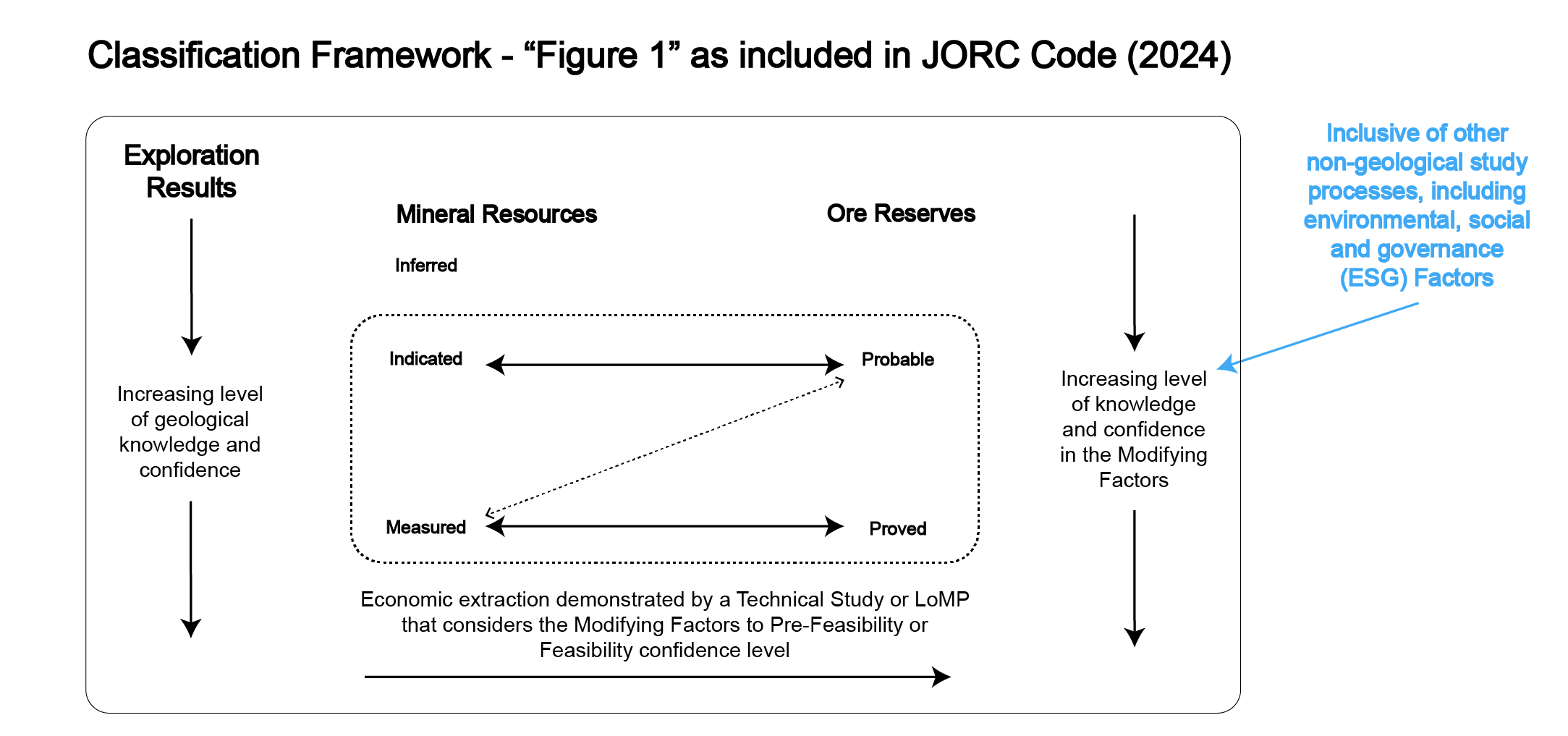
Mineral Resources are subdivided into three categories based on increasing levels of geological confidence 5:
- Inferred Mineral Resource: This is the lowest level of confidence. The quantity and grade are estimated from limited geological evidence and sampling. It is sufficient to imply but not verify geological and grade continuity. Inferred Resources have a high degree of uncertainty and cannot be converted into an Ore Reserve. They are often viewed as speculative and require further exploration to be upgraded.
- Indicated Mineral Resource: This category has a moderate level of confidence. The quantity, grade, density, and other characteristics are estimated from information that is detailed and reliable enough to assume geological and grade continuity between points of observation (e.g., drill holes). An Indicated Resource is sufficiently well-defined to support preliminary mine planning and evaluation of economic viability.
- Measured Mineral Resource: This is the highest level of confidence. The geological evidence is so detailed and reliable (e.g., from closely spaced drilling) that geological and grade continuity is confirmed. A Measured Resource is understood well enough to support detailed mine planning and a final evaluation of economic viability.
3.3 Step 3: The Conversion to an Ore Reserve
The ultimate goal for most mining projects is to demonstrate that a Mineral Resource can be mined profitably. This is achieved by converting it into an Ore Reserve. An Ore Reserve is defined as the economically mineable part of an Indicated and/or Measured Mineral Resource. This conversion is a rigorous process and cannot be done on Inferred Resources.
The critical step in this conversion is the application of Modifying Factors through, at a minimum, a Pre-Feasibility Study (PFS). A PFS must demonstrate that a technically achievable and economically viable mine plan can be developed.
3.3.1 A Deep Dive into the Modifying Factors
Modifying Factors are all the considerations, beyond pure geology, that are used to assess the viability of a project. They represent the bridge between a geological resource and a real-world, economic reserve. The universe of these factors has expanded significantly over time, with ESG issues moving from secondary concerns to primary drivers of project risk and value. The proposed 2024 JORC update formally elevates the importance of ESG and risk assessment in public reporting, reflecting this shift.
| Modifying Factor | Description and Practical Examples |
|---|---|
| Mining | Considerations of the mining method, mine design, dilution, and ore loss. Example: Is the deposit suitable for low-cost open-pit mining or will it require more expensive underground methods? |
| Processing & Metallurgical | The method of extracting the valuable metal from the ore and the percentage recovery. Example: Can the gold be recovered using simple cyanide leaching with 95% recovery, or does it require complex and costly flotation with only 75% recovery? |
| Infrastructure | Access to power, water, roads, ports, and accommodation for the workforce. Example: The project is in a remote location and requires the construction of a 100 km access road and a dedicated power plant, significantly increasing capital costs. |
| Economic | Capital and operating cost estimates, commodity prices, exchange rates, and overall financial viability (NPV, IRR). Example: At a copper price of 8,000 USD/tonne the project is profitable, but at 6,500 USD/tonne it is not. |
| Marketing | The ability to sell the final product; existence of buyers, transport logistics, and offtake agreements. Example: The mine will produce a specialty concentrate with impurities that only a few smelters in the world can process. |
| Legal | The legal status of the mineral tenements, royalties, and any legal agreements. Example: Is the mining license granted and in good standing? Are there any outstanding legal challenges to the company’s title? |
| Environmental | The assessment of environmental impacts, waste disposal (tailings management), water management, and the requirements for closure and rehabilitation. Example: The project requires a permit for a new tailings storage facility, which is facing public opposition and regulatory delays. |
| Social | The relationship with local communities, Indigenous groups, and other stakeholders; the “social license to operate.” Example: The company has not secured the support of local landowners, who are blocking access to the site. |
| Governmental | The relationship with government, political stability, the permitting process, and taxation regimes. Example: A recent change in government has led to a proposed increase in the national mining royalty rate, threatening the project’s economics. |
3.3.2 The Final Classification: Probable and Proved Ore Reserves
Once the Modifying Factors have been successfully applied in a technical study, the corresponding portion of the Mineral Resource is converted to an Ore Reserve. Like Resources, Reserves are classified based on confidence 5:
- Probable Ore Reserve: This is the economically mineable part of an Indicated Mineral Resource. In some circumstances, where confidence in one or more Modifying Factors is lower, it can also be derived from a Measured Mineral Resource. The confidence level is sufficient to serve as the basis for a decision to proceed with development.
- Proved Ore Reserve: This is the economically mineable part of a Measured Mineral Resource. A Proved Ore Reserve implies a high degree of confidence in the geological estimate and in all the Modifying Factors. It represents the highest confidence category of reserve and underpins the most detailed mine planning and financial forecasts.
The entire classification system can be visualized as a framework where assets move from left to right with increasing geological knowledge, and from top to bottom with increasing confidence in the technical and economic modifying factors.
| Increasing Geological Confidence → | Exploration Results | Inferred Resource | Indicated Resource | Measured Resource |
|---|---|---|---|---|
| ↓ Increasing Confidence in Modifying Factors | (Cannot be converted to an Ore Reserve) | ↓ | ↓ | |
| Technical & Economic Studies (PFS, FS) | Probable Ore Reserve | Proved Ore Reserve |
Part III: The JORC Reporting Framework in Practice
The principles and classifications of the JORC Code are brought to life through its primary compliance document: Table 1. This table ensures that the principles of Transparency, Materiality, and Competence are met in practice for every Public Report.
4.1 Understanding JORC Table 1: The Engine of Transparency
Table 1 is a comprehensive checklist of assessment and reporting criteria that a Competent Person must consider and report on. It is structured into sections that follow the project lifecycle 16:
- Section 1: Sampling Techniques and Data
- Section 2: Reporting of Exploration Results
- Section 3: Estimation and Reporting of Mineral Resources
- Section 4: Estimation and Reporting of Ore Reserves
- Section 5: Estimation and Reporting of Diamonds and Other Gemstones
For any Public Report that discloses Exploration Results, Mineral Resources, or Ore Reserves for the first time, or reports a material change to a previous estimate, a summary of all relevant sections of Table 1 must be appended to the report.
Table 1 is far more than a simple checklist. For each criterion, the Competent Person is required to provide detailed commentary explaining the procedures used, the assumptions made, and the judgments reached. For example, under the “Quality of assay data and laboratory tests” criterion, the CP must describe the QA/QC protocols, state whether acceptable levels of accuracy and precision have been established, and discuss the results. This process forces the CP to create a detailed public justification for their work, creating a comprehensive technical document that underpins the headline figures and allows for rigorous due diligence and peer review.
4.2 The “If Not, Why Not” Basis of Reporting
The genius of the Table 1 framework lies in a simple but powerful rule: it must be completed on an “if not, why not” basis. This means that for every single criterion in the relevant sections of the table, the Competent Person must provide commentary. If a particular criterion is not applicable or has not been addressed for some reason, the CP cannot simply leave it blank. They must explicitly state that it has been omitted and explain the justification for doing so.
This principle of justified omission is what gives the Code its teeth. It prevents reporters from ignoring inconvenient topics or difficult questions. For instance, one criterion in Section 1 is “Audits or reviews”. If the project’s sampling and data have not been subjected to an independent audit, the CP must state this. This transparently communicates to the investor that a certain level of external verification is absent, which may represent a higher level of risk. The “if not, why not” basis effectively turns the absence of information into a material piece of information itself, perfectly upholding the principles of Transparency and Materiality by ensuring there can be no misleading by omission.
Conclusion: Applying the JORC Code for Informed Analysis
The JORC Code is the bedrock of public reporting in the minerals industry, providing a disciplined framework that fosters investor confidence and enables an efficient global market for mineral assets. It is a system built on the foundational principles of Transparency, Materiality, and Competence, with the expert and accountable Competent Person at its core.
5.1 Summary of the JORC Workflow: From Data to Value
The journey from a patch of ground to a declared Ore Reserve is a systematic process of de-risking, all documented under the JORC framework. It begins with the collection of high-quality, verifiable data from drilling and sampling, governed by rigorous QA/QC protocols. This data underpins the estimation of a Mineral Resource, which classifies the geological endowment into categories of increasing confidence. Finally, through the application of real-world Modifying Factors in detailed technical and economic studies, the economically mineable portion of that resource is converted into a tangible Ore Reserve. Every step of this journey, with all its assumptions and judgments, is laid bare for scrutiny in the mandatory Table 1 checklist.
5.2 The Future of JORC: A Dynamic Code for a Changing World
The JORC Code is not a static document. It is periodically reviewed and updated to remain relevant in a world of evolving technologies, shifting investor priorities, and changing societal expectations. The comprehensive review process leading to the proposed 2024 JORC Code update is a testament to this dynamism. This update places a major new emphasis on the transparent reporting of Environmental, Social, and Governance (ESG) factors, clarifies the responsibilities of the Competent Person through the introduction of the Specialist role, and formalizes the requirement for risk and opportunity analysis.
This evolution demonstrates that the industry’s definition of what is “material” to an investor has broadened significantly beyond grade and tonnage. The ability of a project to navigate the complex web of environmental regulations, community relations, and political risks is now just as critical to its value as its geology. By adapting to these changes, the JORC Code ensures it remains the most effective tool for investor protection and informed decision-making in the modern minerals industry.
5.3 Final Considerations for Interpreting JORC-Compliant Reports
For any reader, from a novice investor to a seasoned analyst, a JORC-compliant report contains the information needed to perform a sophisticated evaluation. The key is to look beyond the headline numbers and ask the right questions, using the Code’s principles as a guide:
- Competence: Who is the Competent Person? What is their specific, relevant experience for this deposit type and activity? Is their consent statement clear?
- Data Quality: What does Table 1, Section 1 reveal about the drilling, sampling, and especially the QA/QC program? Are the results of standards, blanks, and duplicates acceptable? Was sample recovery high?
- Geological Confidence: What is the ratio of high-confidence resources (Measured and Indicated) to low-confidence resources (Inferred)? A project dominated by Inferred Resources carries significantly higher geological risk.
- Economic Viability: What are the key risks and assumptions detailed in the Modifying Factors? Has the company transparently addressed potential challenges related to metallurgy, infrastructure, environmental permitting, and social license to operate?
By seeking answers to these questions, any user of a JORC report can leverage the framework’s power to look behind the curtain, understand the true foundations of a project’s stated value, and make a truly informed decision.